5 Ways NY Metro Teams Are Beating Ribbon Cable Shortages
Ribbon fiber shortages are impacting AI and enterprise builds. Learn 5 ways teams are avoiding costly infrastructure delays.
Data center cooling is evolving fast. Learn how Eaton and Boyd are shaping cooling systems for modern, high-performance infrastructure.
With Boyd’s thermal business now part of Eaton, data center cooling is shifting toward integrated systems where power and thermal management are engineered together to support higher-density, more efficient infrastructure.
Not long ago, cooling was something teams figured out after everything else was designed.
That’s no longer the case.
As infrastructure becomes more powerful, it also becomes more thermally complex. Higher-density environments generate more heat, and that heat directly affects performance, uptime, and long-term cost.
This is where the shift becomes clear. Data center cooling is no longer just about temperature control, it’s about enabling the entire system to function efficiently.
The Eaton and Boyd alignment reflects that reality. It signals a move toward treating cooling as a core part of infrastructure strategy, not just a supporting layer.
Eaton has long been a leader in power distribution, backup systems, and reliability. Boyd brings deep expertise in thermal management and engineered cooling solutions.
When these capabilities come together, the result is not just expansion, it’s alignment.
Instead of designing systems in isolation, organizations can now think in terms of connected infrastructure, where power and cooling are engineered together from the start.
|
Infrastructure Area |
Traditional Approach |
Integrated Approach |
|
Power + Cooling |
Designed separately |
Designed together |
|
Efficiency |
Inconsistent performance |
System-wide optimization |
|
Scalability |
Limited by system gaps |
Built for future growth |
|
Reliability |
Reactive fixes |
Predictable performance |
This is the real impact behind the acquisition. It’s not just about adding capability, it’s about improving how systems are designed and how they perform over time.
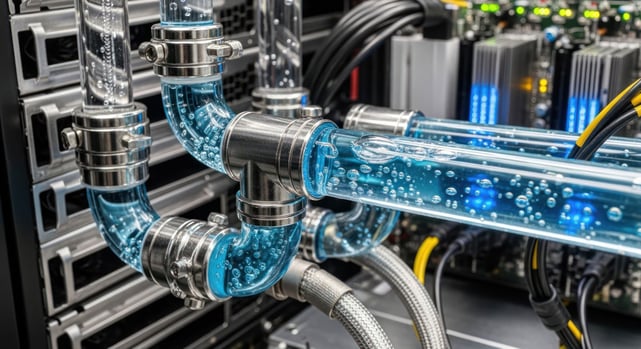
Because traditional air-based systems are reaching their limits in high-density environments.
Air cooling still plays a role, but it struggles to keep up as compute loads increase. That’s where data center liquid cooling becomes more relevant.
Liquid absorbs and transfers heat more efficiently, making it a strong fit for modern workloads.
You’ll typically see this applied through:
This doesn’t mean air cooling disappears. Instead, cooling technology is becoming more adaptive, using the right method for the right environment.
A question that’s starting to surface more often is: how much water does AI use?
The answer depends on the cooling method. Some systems rely on water-based cooling, while others use engineered fluids in closed-loop systems designed to minimize waste.
But the more important takeaway is this: modern cooling solutions for data centers are being designed with efficiency in mind.
That includes:
As infrastructure evolves, the focus isn’t just on handling more heat, it’s on doing it smarter.
If you’re involved in infrastructure decisions, the conversation has shifted from reactive fixes to proactive design.
Here are the questions worth asking:
These are the factors that determine whether a system performs under pressure or struggles to keep up.
At Advanced Business Communications, we focus on the full infrastructure picture: power, fiber, and system design working together.
Through partnerships with Eaton and Corning, we help organizations move beyond fragmented solutions and toward integrated infrastructure strategies that are built to last.
This is where experience matters. Because when systems become more complex, the margin for error gets smaller.
And getting it right from the beginning makes all the difference.
Data center cooling has moved from a supporting role to a central part of infrastructure strategy.
As systems become more powerful and environments more demanding, the ability to manage heat efficiently is directly tied to performance, reliability, and long-term cost. The alignment between Eaton and Boyd reflects a broader shift toward integrated thinking, where power and cooling are no longer designed in isolation, but as part of a unified system.
For organizations planning what comes next, this isn’t just about adopting new technology. It’s about making smarter decisions earlier, designing infrastructure that can scale, adapt, and perform under increasing pressure.
The real advantage comes from getting that foundation right.
If you're evaluating your current environment or planning ahead, a clear strategy starts with understanding how your power and cooling systems work together.
Start your A.C.E Assessment:

Ribbon fiber shortages are impacting AI and enterprise builds. Learn 5 ways teams are avoiding costly infrastructure delays.
Explore a firsthand account of the Corning Optical Communications Headquarters tour in this engaging blog post. Join us for an inside look at the...
Discover how ABC integrates Airspan wireless, Corning fiber, and Eaton power to deliver secure, scalable, future-ready infrastructure.