Next-Gen LAN Knowledge Center
Explore the Next-Gen LAN Knowledge Center for insights on Corning's solutions in software-defined networking and remote powering. Find resources to...
Learn why modern data centers are adopting universal cable tray fittings to simplify installations and support scalable infrastructure growth.
As modern infrastructure projects continue growing in complexity, organizations are looking for smarter ways to simplify deployments without sacrificing scalability. That’s especially true in data centers, healthcare facilities, enterprise campuses, and large commercial buildings where cable management systems must support both current operational needs and future expansion.
Traditional cable tray installations often require multiple specialized components for bends, tees, and crosses. While that approach has worked for years, today’s infrastructure environments are demanding more flexibility, faster deployment timelines, and simpler installation strategies.
That’s why universal cable tray fittings are becoming increasingly important in modern electrical cable tray systems.
Eaton’s newly announced B-Line Series 3-in-1 Universal Fitting is one example of how cable tray infrastructure is evolving. Designed to reduce installation complexity, the fitting can be field-modified to create horizontal bends, tees, or crosses using one configurable solution instead of multiple dedicated fittings.
For organizations planning large-scale deployments throughout New Jersey, New York City, and the broader Northeast corridor, simplifying cable tray infrastructure can help reduce delays, improve planning flexibility, and support long-term scalability.
Infrastructure environments are changing quickly.
Modern enterprise buildings now support significantly more connectivity, power distribution, wireless infrastructure, and high-density cabling than they did even a few years ago. As a result, cable tray systems are no longer simply overhead pathways for cable routing. They’ve become a critical part of scalable infrastructure planning.
In large enterprise deployments, cable tray layouts often need to adapt during construction due to:
This is particularly common in the New York City and North Jersey markets, where retrofit projects and large commercial modernization initiatives frequently require infrastructure flexibility during deployment.
Northern New Jersey alone remains one of the country’s most concentrated enterprise infrastructure corridors due to its proximity to Manhattan data centers, carrier hotels, healthcare systems, and financial institutions. Meanwhile, New York City continues investing heavily in commercial modernization, healthcare infrastructure, and large-scale connectivity upgrades.
As these environments evolve, infrastructure teams need cable tray systems that can adapt with them.
Modern infrastructure environments are becoming more complex as organizations balance scalability, connectivity, power distribution, and future growth planning.
In a recent episode of Fibreside, ABC’s Ken DePalo and Ed O’Brien discuss how evolving enterprise environments are reshaping infrastructure design across data centers, healthcare systems, financial institutions, and commercial buildings.
→ Watch Ed O’Brien and Ken DePalo discuss this further on their Fibreside Podcast
A universal cable tray fitting is designed to support multiple cable tray configurations using one adaptable fitting instead of several separate components.
Rather than requiring different fittings for:
A universal fitting allows installers to modify the configuration directly in the field.
This creates several advantages for contractors, consultants, engineers, and enterprise teams managing large infrastructure deployments.
Eaton’s B-Line Series 3-in-1 Universal Fitting was specifically designed to support this type of deployment flexibility.
Instead of managing multiple specialized fittings, teams can simplify planning and installation while maintaining compatibility with broader B-Line cable tray systems.
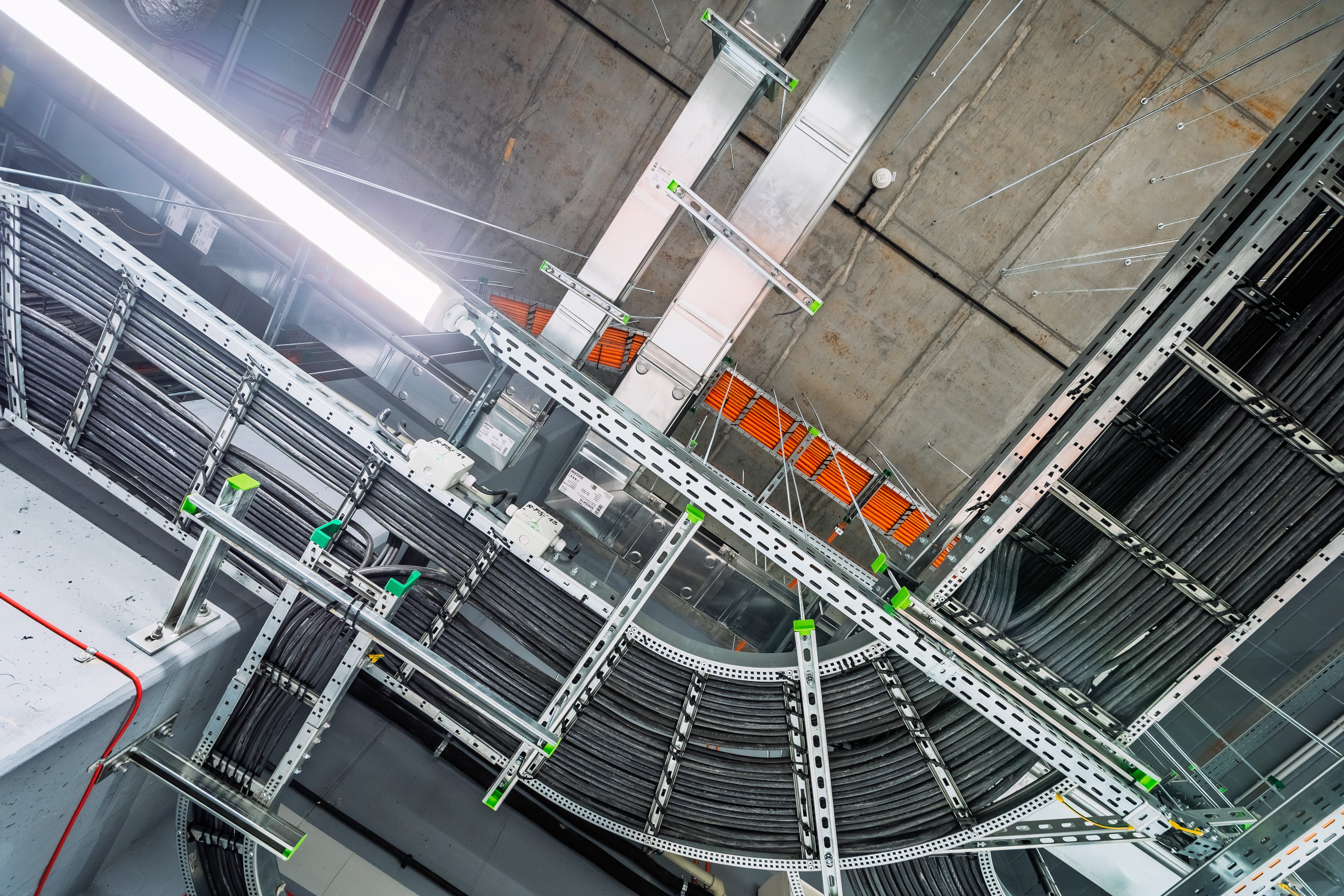
Eaton’s B-Line cable tray portfolio has long been recognized throughout enterprise and industrial infrastructure environments for supporting scalable cable management systems.
The new B-Line Series 3-in-1 Universal Fitting expands on that flexibility by helping organizations simplify deployment planning and field coordination.
Allows installers to make adjustments during deployment without requiring multiple dedicated fittings.
Helps minimize the number of separate tray components needed during large projects.
Useful for data centers, enterprise campuses, healthcare environments, and industrial facilities.
Supports evolving layouts and infrastructure adjustments during construction.
Integrates with Eaton’s established cable tray ecosystem.
For organizations managing large enterprise deployments, these advantages can help reduce unnecessary project friction during installation.
Large infrastructure projects rarely stay identical from design through final installation.
As equipment layouts evolve and contractors coordinate multiple systems simultaneously, field modifications often become necessary. Universal cable tray fittings help simplify those adjustments without requiring multiple specialty components.
Today’s cable tray systems support:
As convergence increases, flexibility becomes more important across enterprise environments.
Managing fewer specialized fittings can help simplify procurement, staging, and deployment coordination.
For large projects throughout NYC and New Jersey where timelines are tightly managed, reducing installation complexity can make a significant operational difference.
Scalable infrastructure planning is no longer optional.
Organizations are increasingly designing environments that can support future growth without requiring complete infrastructure redesigns later. Flexible cable tray systems help support that long-term planning strategy.
Universal fittings help installers adapt more efficiently during deployment. Instead of waiting for additional specialty fittings, teams can make modifications directly in the field while maintaining project momentum.
That flexibility becomes especially valuable in fast-moving enterprise and commercial deployments.
The three most common cable tray types include:
Designed for maximum ventilation and commonly used in enterprise and industrial environments.
Provides additional cable protection and is often used where sensitive wiring requires more coverage.
Offers moderate cable support while balancing airflow and cable containment.
Different electrical cable tray systems are selected based on environment, cable density, airflow requirements, and infrastructure goals.
Two of the most widely used tray system categories include:
Commonly used in data centers and enterprise infrastructure environments due to airflow and scalability benefits.
Frequently used in commercial and industrial applications where additional cable support is needed.
Modern enterprise deployments often combine multiple tray system strategies depending on operational requirements.
Yes.
B-Line is part of Eaton’s infrastructure portfolio and supports a wide range of cable management, enclosure, power distribution, and enterprise infrastructure solutions.
Today, Eaton’s B-Line cable tray systems are widely used across:
The load rating of a B-Line cable tray depends on several factors including the tray type, width, material, span length, and overall installation environment. Different cable tray configurations are designed to support different infrastructure demands, ranging from lighter commercial applications to high-density enterprise and data center deployments. Because every environment has unique power, cabling, and structural requirements, organizations should work with experienced infrastructure teams to evaluate the proper cable tray design, support spacing, and load capacity for their specific project goals.
Different B-Line cable tray systems are designed to support varying infrastructure requirements ranging from light commercial applications to high-density enterprise environments.
Organizations should work with experienced infrastructure teams to evaluate proper tray sizing, support requirements, and installation standards for their specific deployment goals.
Infrastructure teams today are balancing multiple challenges simultaneously:
As enterprise environments continue evolving, flexible infrastructure solutions become increasingly valuable.
That’s why organizations throughout New Jersey and New York are investing more heavily in scalable cable management systems, future-ready infrastructure design, and deployment strategies that reduce long-term operational friction.
At Advanced Business Communications, we help organizations simplify modern infrastructure planning across fiber, power, wireless, and enterprise connectivity environments.
Through partnerships with Eaton, Corning, and Airspan, ABC supports scalable infrastructure deployments throughout New York City, Northern New Jersey, and enterprise environments across the Northeast.
Whether your organization is:
ABC helps simplify the process through infrastructure consultation, deployment planning, product expertise, and scalable design support.
Modern infrastructure environments demand more flexibility than ever before.
As cable tray systems continue evolving, organizations that plan smarter today will be better positioned to support tomorrow’s connectivity, power, and operational demands. The right cable management strategy can help reduce deployment complexity, improve scalability, and simplify long-term infrastructure growth.
Ready to evaluate your infrastructure environment?
Our A.C.E. Assessment helps organizations evaluate:
Build smarter. Scale faster. Future-proof your infrastructure with ABC.

Explore the Next-Gen LAN Knowledge Center for insights on Corning's solutions in software-defined networking and remote powering. Find resources to...
Discover the benefits of Eaton's High Density rack PDU, offering configurability, improved outlet counts, and color chassis options for efficient...
Ribbon fiber shortages are impacting AI and enterprise builds. Learn 5 ways teams are avoiding costly infrastructure delays.